Comfort eating doesn’t start with a binge. It starts with honey (or sugar) in your coffee, ends with 10 cookies in one sitting, and leaves you figuring out how to climb back on the wagon.
98.7.
I didn’t step off and back on this time. I didn’t need to. I knew exactly how I got here.
Last entry, I was celebrating 97.6. This week, the scale went up 1.1 kilos. And if I’m being honest about comfort eating, which is the whole point of this post, I have to tell you how.
It started with coffee.
I like my coffee dark. No milk, no sugar, no nonsense. My boyfriend, on the other hand, is a latte man. When he came over to visit, I found myself adding milk and honey to my cup.
I don’t really know why. Sometimes, I just want to experience what he’s experiencing. Taste what he tastes. Sit across from him with the same kind of cup. And maybe understand him better.
It’s a small thing. That’s the problem with small things.
Then came the grilled pork. Then the ensaymada. Then the chocolate chip cookies, the soft, buttery kind made by Dii.
Dii is a dear friend and my neighbor here (literally a few doors away), and she loves to cook. Baking and cooking are her hobbies. Mine is eating. And not just bits and pieces, no ma’am. We’re talking at least 10 cookies in one sitting.
I felt guilty every time. And somehow, every time, I let myself keep eating anyway.
Before I knew it, the week had quietly slipped back into the habits I thought I’d left behind. One “it’s fine” after another.
Then he went back to the Philippines.
And boy, did it get lonely.
When you’re used to having someone by your side every day, and then, poof, they’re gone. You can prepare yourself all you want. It still doesn’t come easy.
The apartment felt bigger. The evenings felt longer. And I did what I’ve always done when the quiet gets too loud. I reached for sweets. Then more sweets. Then lots and lots of sweets.
That’s comfort eating. Not hunger. Just wanting something, anything, to fill the space someone left behind.
Then the pain on my lower right side flared up again. It woke me up, literally, and with it came the reality of my relationship with food.
It isn’t harmonious anymore. It’s obsessive.
So when I saw 98.7 on the scale, I decided, yet again, that this is not looking good.
Here’s what the research says about that “comfort”
I wanted to understand why sweets feel like a hug, so I went looking.
It turns out the sugar rush is a myth. Literally. A 2019 meta-analysis of 31 studies with 1,259 participants found that carbohydrates had no positive effect on any aspect of mood, at any point after eating them. The researchers concluded their findings could help show the public that “the ‘sugar rush’ is a myth” (Mantantzis et al., 2019, Abstract). If anything, eating sugar increased fatigue and reduced alertness within the first hour (Mantantzis et al., 2019).
So why does it feel good? Mantantzis, the study’s lead researcher, offered a theory: people often eat sugar while spending time with friends and doing fun things (Mantantzis, as cited in Vice, 2019).
I read that and thought about the milk and honey in my coffee.
The sweetness was never the comfort. He was.
There’s a less romantic side too. The World Health Organization (2015) recommends that adults keep free sugars below 10% of their total daily energy intake, pointing to evidence that eating more sugar is associated with weight gain. Free sugars include the ones naturally found in honey. Yes, even the honey in my “just this once” latte.
And with my grade 2 fatty liver, this part stung. A review in the Journal of Hepatology explains that “fructose precipitates fat accumulation in the liver” (Jensen et al., 2018, Abstract), and that early clinical studies suggest cutting back on sugary drinks and added sugars may significantly reduce liver fat (Jensen et al., 2018).
Why falling off the wagon feels so final
This was the part that actually helped me.
Researchers studying dieting behavior identified two styles: rigid control, which runs on all-or-nothing rules, and flexible control. Rigid control was linked to higher BMI and more frequent, more severe binge eating. Flexible control, on the other hand, was associated with lower BMI, fewer binges, and “a higher probability of successful weight reduction” (Westenhoefer et al., 1999, Abstract).
That’s falling off the wagon in one sentence. When the rule is “no sugar, ever,” one ensaymada doesn’t feel like one ensaymada. It feels like proof you’ve failed. So you eat the second one. And the third.
One week of comfort eating didn’t undo everything. It just felt like it did.
I told Joyce.
I think she got a little pissed. (I love you, Bibii.)
But then she said the thing I needed to hear. The important thing is how we recover from the fall. If you fall, stand up again and keep going. Just don’t let yourself fall too far.
Her words were kinder. My version: falling too far is borderline stupid.
Tough love. The best kind.
The luggage got a little heavier this week. I’m choosing to carry it as a lesson, not a verdict.
The wagon is still there. I just have to climb back on.
Entry #3
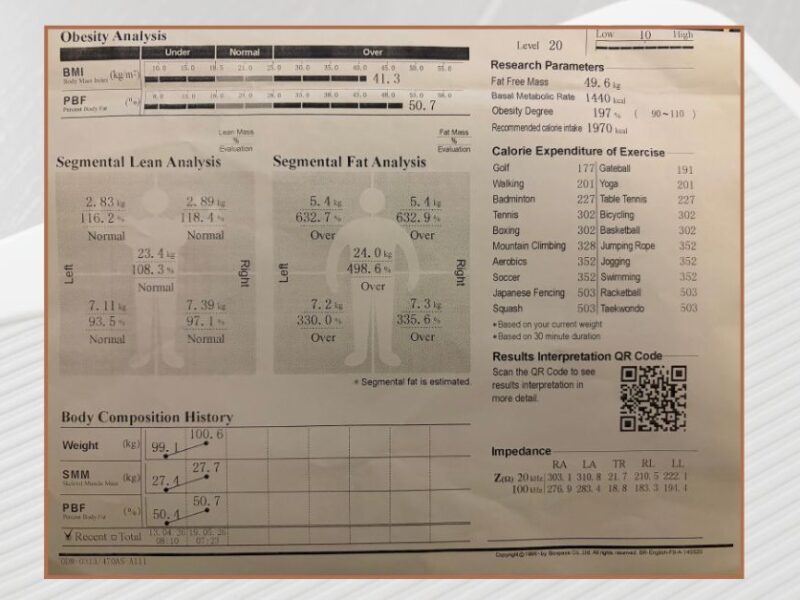
Baseline weight: 100 kg
Current weight: 98.7 kg
Lost so far: 1.3 kg
To go: 43.7 kg
Goal: 55 kg
Emotional Temp: Lonely, guilty, and climbing back on
This is my personal journey, not medical or nutritional advice. Please talk to a healthcare professional before making changes to your diet or exercise.
References
Jensen, T., Abdelmalek, M. F., Sullivan, S., Nadeau, K. J., Green, M., Roncal, C., Nakagawa, T., Kuwabara, M., Sato, Y., Kang, D.-H., Tolan, D. R., Sanchez-Lozada, L. G., Rosen, H. R., Lanaspa, M. A., Diehl, A. M., & Johnson, R. J. (2018). Fructose and sugar: A major mediator of non-alcoholic fatty liver disease. Journal of Hepatology, 68(5), 1063–1075. https://doi.org/10.1016/j.jhep.2018.01.019
Mantantzis, K., Schlaghecken, F., Sünram-Lea, S. I., & Maylor, E. A. (2019). Sugar rush or sugar crash? A meta-analysis of carbohydrate effects on mood. Neuroscience & Biobehavioral Reviews, 101, 45–67. https://doi.org/10.1016/j.neubiorev.2019.03.016
The sugar high might be a myth. (2019). Vice. https://www.vice.com/en/article/the-sugar-high-might-be-a-myth/
Westenhoefer, J., Stunkard, A. J., & Pudel, V. (1999). Validation of the flexible and rigid control dimensions of dietary restraint. International Journal of Eating Disorders, 26(1), 53–64. https://doi.org/10.1002/(SICI)1098-108X(199907)26:1<53::AID-EAT7>3.0.CO;2-N
World Health Organization. (2015). Guideline: Sugars intake for adults and children. https://www.who.int/publications/i/item/9789241549028