Ten-minute walks, a new WinMart down the road, and a cold drink habit I finally traded in. This is how to read nutrition labels the way I learned to, and why the healthiest thing I bought this week didn’t even have one.
96.15.
Down 0.95 kilos from my last entry about walking after eating.
Not dramatic. Not even a full kilo. I’ll take it.
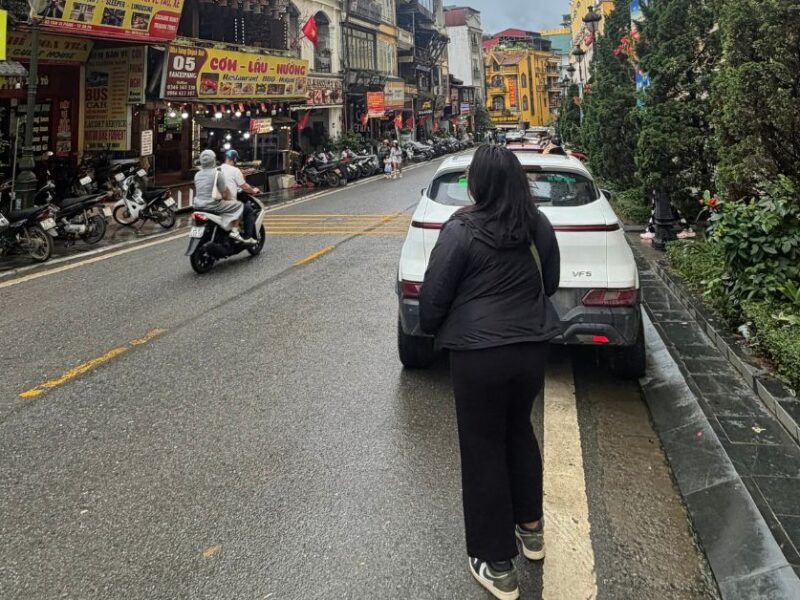
The night walks
Here’s something I had to unlearn: a walk doesn’t have to be long to count.
Some nights I only have 10 minutes. Some nights, 20 minutes. I used to think that wasn’t worth putting on shoes for. Now I just go.
And lately, I don’t always go alone.
I found a walking buddy. His name is Kris. He’s a fellow Filipino, a teacher here in Quy Nhon, and a friend of both mine and Dii’s. We all live in the same building, which makes this whole arrangement very low effort, in the best way.
We don’t schedule anything. There’s no “see you at 7 p.m.” text. We just bump into each other on the way out, and then we walk together. Some nights I walk and he doesn’t. Some nights he walks and I don’t. No pressure, no guilt, no one keeping score.
And funny enough, the nights with no plan are the ones that go the longest. A walk I meant to keep at 30 minutes sometimes turns into more than an hour, because we get to talking and forget to turn back.
If Joyce is my accountability partner, Kris is the opposite kind of support. He doesn’t check in on me. He just happens to be there sometimes, and that’s enough to make 30 minutes feel shorter and an hour feel easy.
It also helps that a new WinMart opened near our area. It’s not where we’re headed every night, but when one of us needs something, we route the walk past it. Two birds, one stone. Steps in, groceries in hand.
Which sounds harmless, until you remember what I used to do in convenience stores.
I love cold drinks. The sweeter and icier, the better. Walking past a glowing fridge full of them at 8 p.m. used to be a done deal before I even reached the door.
So this time, I made myself do one thing first.
Read the label.
How to read nutrition labels?
Start with the serving size and the number of servings in the package, because every number on the label is based on one serving. Then check the % Daily Value: 5% or less of a nutrient per serving is considered low, and 20% or more is considered high (U.S. Food and Drug Administration, n.d.).
That’s it. That’s the whole trick. And I ignored it for years.
The serving size part got me the most. A bottle I always thought of as “one drink” sometimes counts as more than one serving. If the label says one serving and you finish two, you’re getting double everything on that label, sugar included.
Now I check three things before anything goes in my basket: the serving size, the sugar, and the % Daily Value. And when the label is only in Vietnamese, Google Translate and I have a little meeting in the aisle.
It sounds small. But it works, and not just for me. A meta-analysis of 60 studies across 11 countries looked at how food labels affect what people actually eat. Labeling reduced people’s calorie intake by 6.6% and total fat intake by 10.6%, and increased vegetable consumption by 13.5% (Shangguan et al., 2019).
Six point six percent doesn’t sound like much. But neither did 0.95 kilos, and here I am, celebrating it.
The coconut swap
So what did I end up buying instead of a cold sweet drink?
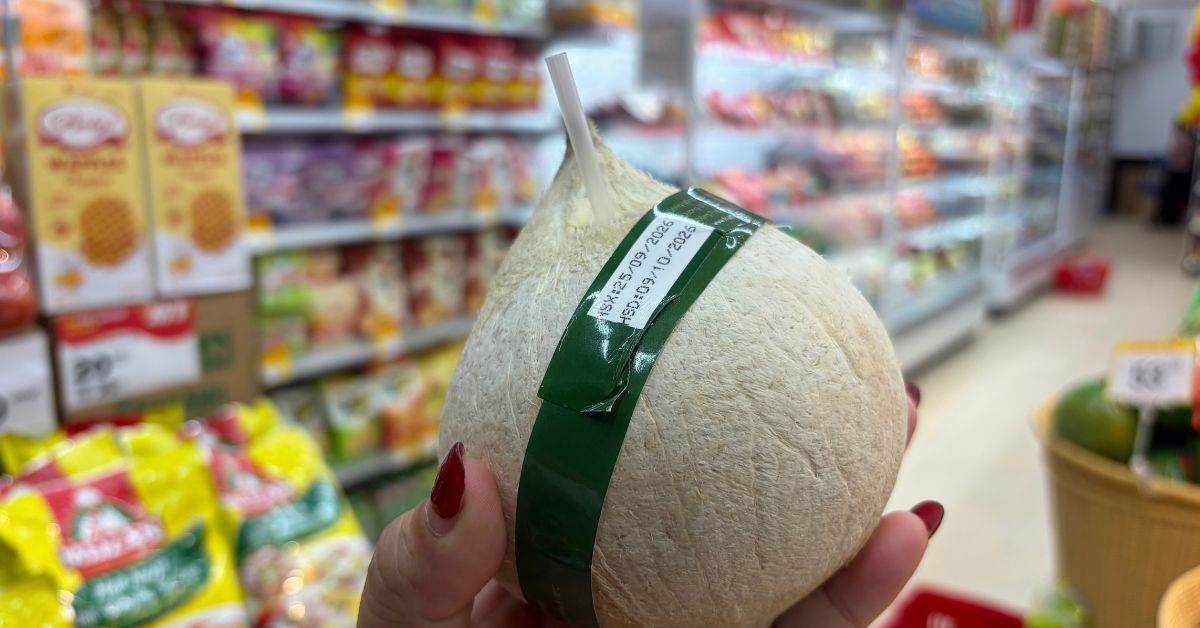
A coconut.
Fresh, cold, with a straw already in it. And yes, it came with a label. I checked. Two lines on a strip of green tape: NSX 25/09/2026 and HSD 09/10/2026. The production date and the expiry date.
No calorie count. No sugar content. No % Daily Value.
So I looked it up myself, and compared it to the kind of drink I used to grab from that fridge.
One cup of coconut water has about 46 calories and 6 grams of sugar, with no added sugar (ReciPal, n.d.). An 8-ounce serving of Coca-Cola, roughly the same amount, has 100 calories and 26 grams of sugar. A standard 12-ounce can has 140 calories and 39 grams (The Coca-Cola Company, n.d.).
Cup for cup, that’s less than half the calories and about a quarter of the sugar.
To be fair, coconut water isn’t sugar-free. It’s a better choice, not a free pass. But I’ll take a coconut with a tape of expiry date over a can of 39 grams any night.
What’s different this time
Ten minutes of walking, sometimes more than an hour. Thirty seconds of reading. One swap.
None of it feels like a diet. It feels like paying attention.
The luggage is 0.95 kilos lighter. And I’m finally reading what I pack into it. And some nights, I have company carrying it.
Entry #5
Baseline weight: 100 kg
Current weight: 96.15 kg
Lost so far: 3.85 kg
To go: 41.15 kg
Goal: 55 kg
Emotional Temp: Curious, mindful, and quietly winning
This is my personal journey, not medical or nutritional advice. Please talk to a healthcare professional before making changes to your diet or exercise.
References
The Coca-Cola Company. (n.d.). How much sugar is in Coca-Cola? Retrieved October 7, 2026, from https://www.coca-cola.com/pk/en/about-us/faq/how-much-sugar-is-in-coca-cola
ReciPal. (n.d.). Nuts, coconut water (liquid from coconuts): Nutrition facts [Data from USDA National Nutrient Database, NDB No. 12119]. Retrieved October 7, 2026, from https://www.recipal.com/ingredients/3697-nutrition-facts-calories-protein-carbs-fat-nuts-coconut-water-liquid-from-coconuts
Shangguan, S., Afshin, A., Shulkin, M., Ma, W., Marsden, D., Smith, J., Saheb-Kashaf, M., Shi, P., Micha, R., Imamura, F., & Mozaffarian, D. (2019). A meta-analysis of food labeling effects on consumer diet behaviors and industry practices. American Journal of Preventive Medicine, 56(2), 300–314. https://doi.org/10.1016/j.amepre.2018.09.024
U.S. Food and Drug Administration. (n.d.). How to understand and use the Nutrition Facts label. Retrieved October 7, 2026, from https://www.fda.gov/food/nutrition-facts-label/how-understand-and-use-nutrition-facts-label